

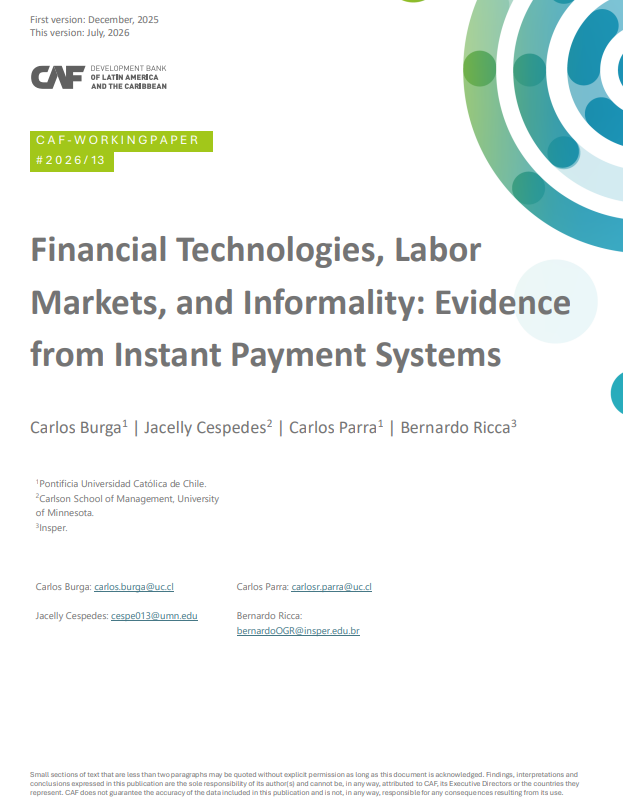
Financial Technologies, Labor Markets, and Informality: Evidence from Instant Payment Systems
Resumen
While technological innovations typically increase wage inequality by favoring skilled workers, we show that instant payment systems instead reduce it. We study the labor market effects of instant payment systems in the context of Brazil’s Pix rollout. Using matched employer-employee data, we implement a triple-difference design that exploits pre-Pix mobile penetration across municipalities, the differential benefits of Pix for small versus large establishments, and the timing of Pix. We find that wages in small establishments rise significantly relative to large establishments after Pix. These gains are concentrated in cash-intensive sectors such as retail and services, with no effects in wholesale or manufacturing. Crucially, wage inequality declines, driven by wage gains in the lower half of the distribution, with no effect at the top. Our evidence points to increased small-firm labor demand, consistent with lower payment frictions. These effects are amplified where low-skill labor is scarce. A calibrated monopsony model implies that uniform Pix adoption would reduce both the within- and between-municipality components of wage dispersion, amplifying the aggregate inequality reduction.
Materia
País / Región
Fecha
2026-09-24Citar de esta publicación
Item perteneciente a la Colección

Excepto si se señala otra cosa, la licencia del ítem se describe como CC-BY-NC-ND
Items Relacionados

Money can buy me life. The Effect of a Basic Pension on Mortality: a Regression Discontinuity Design
This paper estimates the effect of a permanent income increase for the elderly on their health outcomes. Our regression discontinuity design exploits ...
The impact of taxes and social spending on inequality and poverty in Argentina, Bolivia, Brazil, Mexico and Peru: a synthesis of results
We apply a standard tax and benefit incidence analysis to estimate the impact on inequality and poverty of direct taxes, indirect taxes and subsidies, ...
Police reform, training and crime: experimental evidence from colombia's plan cuadrantes
The Plan Nacional de Vigilancia Comunitaria por Cuadrantes (PNVCC) is a new police patrolling program introduced in the eight major cities of Colombia ...