

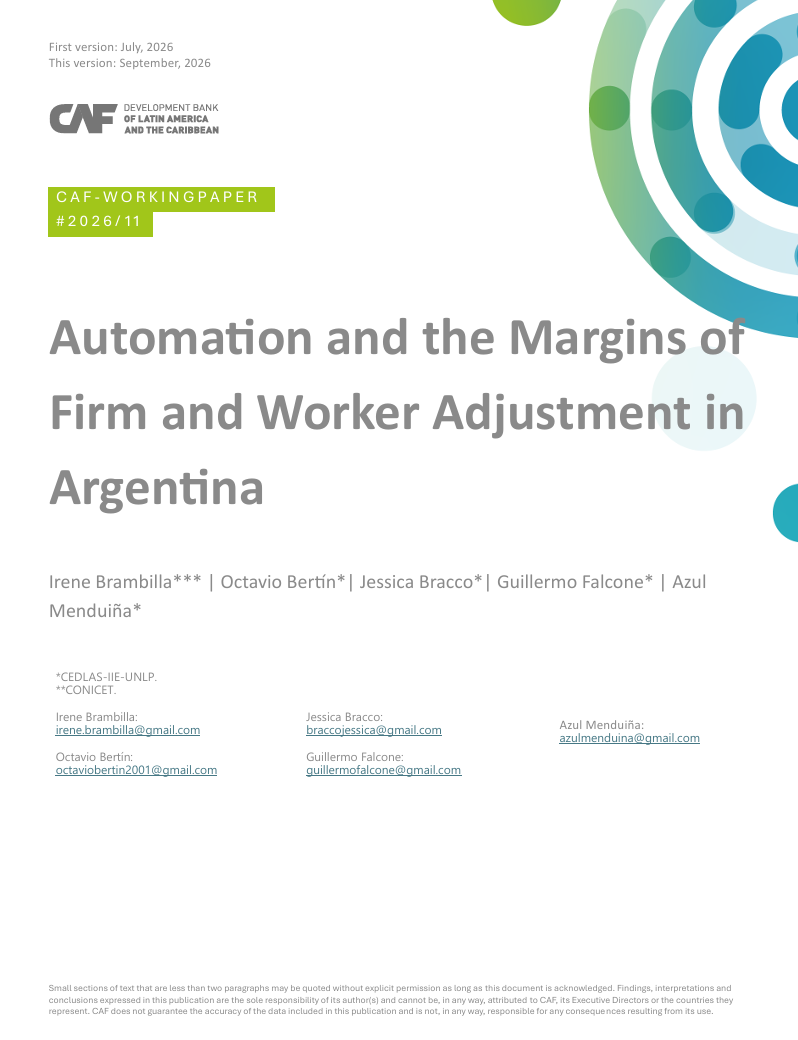
Automation and the Margins of Firm and Worker Adjustment in Argentina
Abstract
We examine how automation reshapes firm labor demand and incumbent-worker trajectories in Argentina over 2007–2022. We link customs records on automation-capital imports to administrative employer–employee and simplified self-employment tax data, identify adoption as discrete import spikes, and estimate stacked event studies comparing adopters and their incumbents with not-yet-adopting firms. Five years after adoption, employment is 19 percent lower and the wage bill 20 percent lower, while firm-level wages barely move; the contraction runs through hiring rather than dismissals. Incumbents’ reported earnings stay flat, but their formal attachment weakens—fewer months in registered wage employment, more exits from the registry, and more transitions into simplified self-employment. Automation costs here appear less as payroll wage cuts than as separations, reallocation, and movement out of registered wage employment.
Subject
Country / Region
Date
2026-09-17Cite this publication
Belongs to collection

Except where otherwise noted, this item's license is described as CC-BY-NC-ND
Items Relacionados
Heterogeneous effects of automation: How are young workers affected by a changing labor market?
We study the effect of automation on labor market outcomes with a focus on young workers and the case of Chile. We develop an index of routine task ...
Digitalization and artificial intelligence in Latin America: employer demand for AI, technical and soft skills
The rapid diffusion of automation and the application of artificial intelligence (AI) to production have boosted productivity and economic growth while ...
Deforestation, Institutions, and Property Rights: Evidence from land titling to indigenous peoples and local communities in Ecuador
Deforestation is a matter of pressing global concern, contributing to declining ecosystem services, biodiversity loss, and ultimately climate change ...