

Digitalization and artificial intelligence in Latin America: employer demand for AI, technical and soft skills
| dc.contributor.author | Maurizio, Roxana | |
| dc.contributor.author | Semeshenko, Viktoriya | |
| dc.contributor.author | Aromí, Daniel | |
| dc.contributor.author | Catania, Sol | |
| dc.contributor.author | Zerdá-Sánchez, Octavio | |
| dc.contributor.author | Llada, Martín | |
| dc.contributor.author | Bonel, María Paula | |
| dc.coverage.spatial | América Latina y el Caribe | es_ES |
| dc.date.accessioned | 2026-09-04T14:26:33Z | |
| dc.date.available | 2026-09-04T14:26:33Z | |
| dc.date.issued | 2026-09-04 | |
| dc.identifier.citation | Maurizio, R., Semeshenko, V., Aromí, D., Catania, S., Zerdá-Sánchez, O., Llada, M., Bonel, M. (2026, September 4). Digitalization and artificial intelligence in Latin America: employer demand for AI, technical and soft skills. Retrieved from https://scioteca.caf.com/handle/123456789/2707 | en_GB |
| dc.identifier.uri | https://scioteca.caf.com/handle/123456789/2707 | |
| dc.description.tableofcontents | The rapid diffusion of automation and the application of artificial intelligence (AI) to production have boosted productivity and economic growth while also posing significant challenges for labor markets. These technological transformations reshape the tasks performed within occupations and, consequently, the skills that employers demand from workers, with potentially disparate effects across groups of workers depending on their exposure to automation and their ability to adapt to new skill requirements. Despite the growing international literature, empirical evidence for Latin America remains scarce. Given the region’s structural specificities, directly extrapolating results from other contexts may be misleading. This paper seeks to help close this gap by providing a robust, evidence-based understanding of the demand for soft, AI-related and non-AI digital skills in four Latin American countries, Argentina, Brazil, Colombia and Mexico, drawing on a novel regional taxonomy and more than one million online job postings. The results show that employers overwhelmingly demand multidimensional and highly complementary skill profiles, with technical non-AI and soft skills appearing jointly, in most cases, in the vast majority of postings. In contrast, explicit demand for AI-related skills remains limited, accounting for less than 3% of postings in all four countries. | es_ES |
| dc.language.iso | en | es_ES |
| dc.rights | CC-BY-NC-ND | es_ES |
| dc.rights.uri | http://creativecommons.org/licenses/by-nc-nd/4.0/ | es_ES |
| dc.subject | Innovación | es_ES |
| dc.subject | Internet y banda ancha | es_ES |
| dc.subject | Trabajo y protección social | es_ES |
| dc.subject | Tecnologías de la información y comunicación (TIC) | es_ES |
| dc.title | Digitalization and artificial intelligence in Latin America: employer demand for AI, technical and soft skills | es_ES |
Files in this item
This item appears in the following Collection(s)
-
6.1 Documentos de trabajo en investigación socioeconómica
En esta colección se encuentran los documentos de trabajo sobre temas económicos y sociales prioritarios para la región.

Except where otherwise noted, this item's license is described as CC-BY-NC-ND
Items Relacionados

Financial Frictions, Occupational Choice and Economic Inequality
We develop a quantitative theory of entrepreneurship, income inequality, and financial frictions disciplined with household data from Brazil. The theory ...
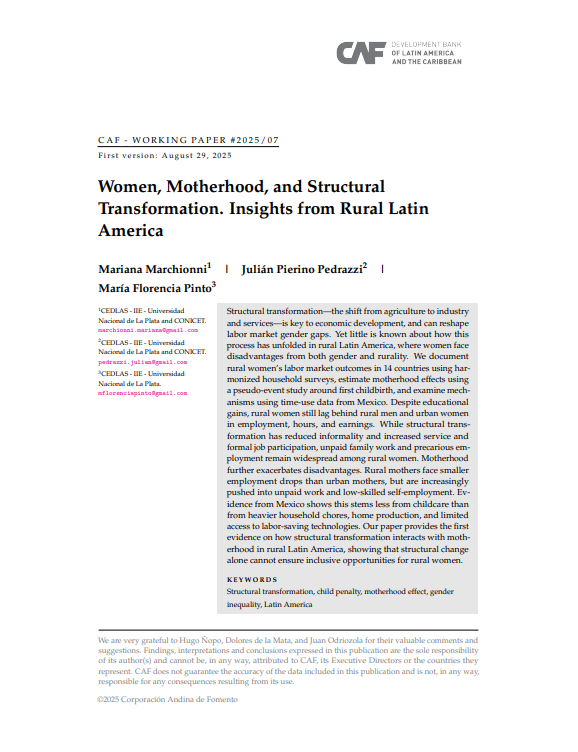
Women, Motherhood, and Structural Transformation. Insights from Rural Latin America
Structural transformation—the shift from agriculture to industry and services—is key to economic development and can reshape labor market gender gaps. ...

Financial Technologies, Labor Markets, and Informality: Evidence from Instant Payment Systems
While technological innovations typically increase wage inequality by favoring skilled workers, we show that instant payment systems instead reduce it. ...