

Measuring Development and Welfare: The Use of Night-lights to Evaluate Programs and Formulate Policy
Resumen
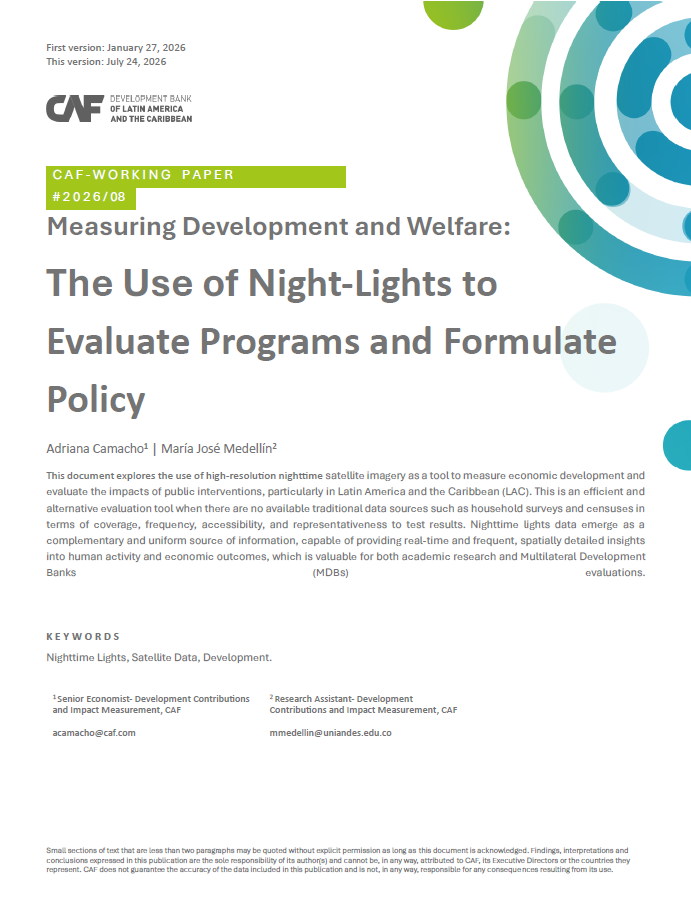
This document explores the use of high-resolution nighttime satellite imagery as a tool to measure economic development and evaluate the impacts of public interventions, particularly in Latin America and the Caribbean (LAC). This is an efficient and alternative evaluation tool when there are no available traditional data sources such as household surveys and censuses in terms of coverage, frequency, accessibility, and representativeness to test results. Nighttime lights data emerge as a complementary and uniform source of information, capable of providing real-time and frequent, spatially detailed insights into human activity and economic outcomes, which is valuable for both academic research and Multilateral Development Banks (MDBs) evaluations.
Materia
País / Región
Fecha
2026-07-28Citar de esta publicación
Item perteneciente a la Colección

Excepto si se señala otra cosa, la licencia del ítem se describe como CC-BY-NC-ND
Items Relacionados
Indicators of Technological Innovation in Latin American and Caribbean Countries - 2015
The following study is one of the results of CAF’s Technological Patents for Development Initiative carried out between 2013 and 2015. Among the main ...
Indicators of Technological Innovation by Regions - 2015
The following study is one of the results of CAF’s Technological Patents for Development Initiative carried out between 2013 and 2015. Among the main ...
Deforestation, Institutions, and Property Rights: Evidence from land titling to indigenous peoples and local communities in Ecuador
Deforestation is a matter of pressing global concern, contributing to declining ecosystem services, biodiversity loss, and ultimately climate change ...