

Labor Market Impacts of an Internship Program on People with Disabilities
Resumen
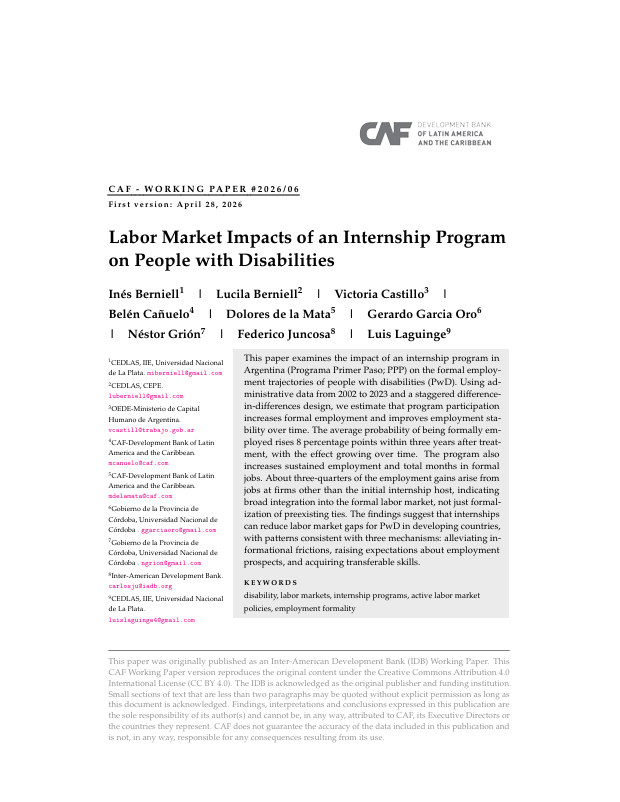
This paper examines the impact of an internship program in Argentina (Programa Primer Paso; PPP) on the formal employment trajectories of people with disabilities (PwD). Using administrative data from 2002 to 2023 and a staggered difference-in-differences design, we estimate that program participation increases formal employment and improves employment stability over time. The average probability of being formally employed rises 8 percentage points within three years after treatment, with the effect growing over time. The program also increases sustained employment and total months in formal jobs. About three-quarters of the employment gains arise from jobs at firms other than the initial internship host, indicating broad integration into the formal labor market, not just formalization of preexisting ties. The findings suggest that internships can reduce labor market gaps for PwD in developing countries, with patterns consistent with three mechanisms: alleviating informational frictions, raising expectations about employment prospects, and acquiring transferable skills.
Materia
País / Región
Fecha
2026-04-28Citar de esta publicación
Item perteneciente a la Colección

Excepto si se señala otra cosa, la licencia del ítem se describe como CC-BY-NC-ND
Items Relacionados
The Value of Free Health Insurance Schemes in Developing Countries
Brazil began the implementation of SUS (Universal Health Insurance) in 1988. To the extent that SUS broke the link between employment contract and health ...
Starting on the right track? The effects of rst job experience on short and long term labor market outcomes
For young job seekers barriers to labor market entry are high, especially in developing countries were information frictions are large. Can first job ...
Housing Subsidies, Labor Supply and Household Welfare. Experimental Evidence from Argentina
We study the impact of a social housing policy program implemented in Argentina, exploiting the random assignment rule to identify the policy's causal ...