

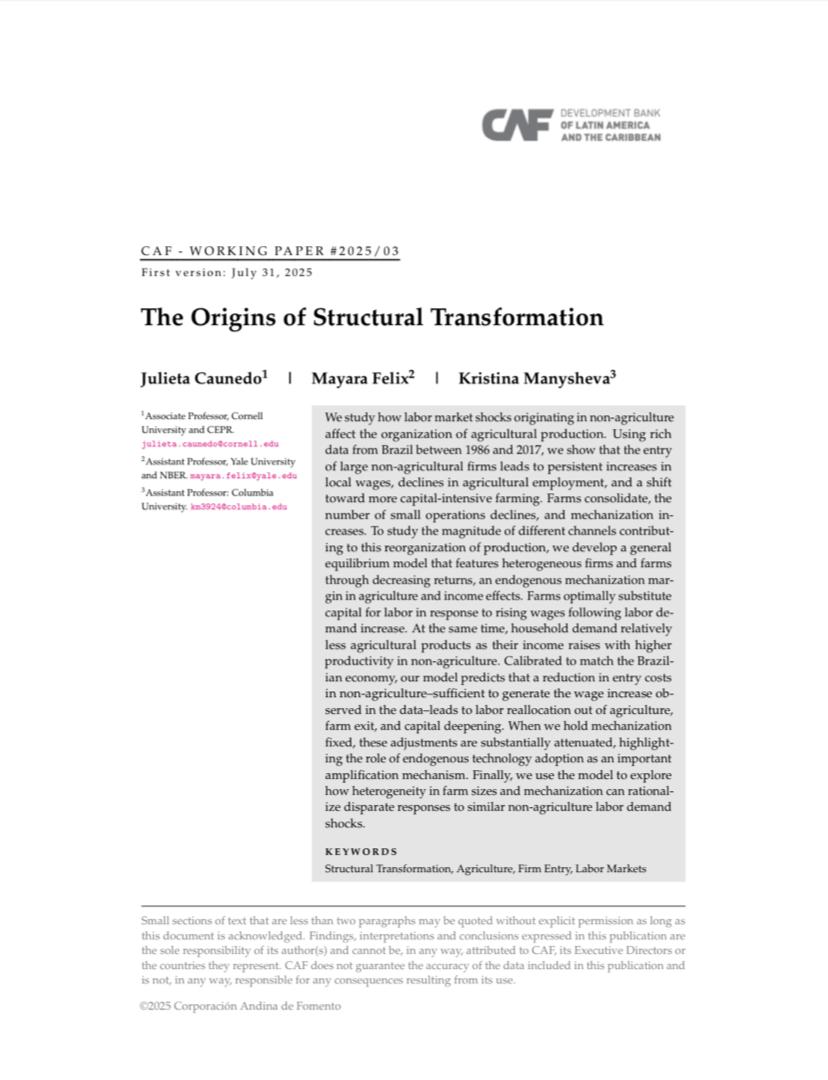
The Origins of Structural Transformation
Resumo
The study examines how labor market shocks originating in non-agriculture affect the organization of agricultural production. Using data from Brazil between 1986 and 2017, it shows that the entry of large non-agricultural firms leads to persistent increases in local wages, declines in agricultural employment, and a shift toward more capital-intensive farming. Farms consolidate, the number of small operations declines, and mechanization increases.
To study the magnitude of this reorganization, we develop a general equilibrium model which predicts that a reduction in entry costs in non-agriculture leads to labor reallocation out of agriculture, farm exit, and capital deepening. When we hold mechanization fixed, these adjustments are substantially attenuated, highlighting the role of endogenous technology adoption as an important amplification mechanism.
Assunto
País / Región
Data
2025-08-29Cite esta publicação
Item que pertence à coleção

Exceto quando indicado o contrário, a licença deste item é descrito como CC-BY-NC-ND
Items Relacionados
Out of Agriculture, Sill Vulnerable: Rural Labor Markets in Latin America
Rural poverty has declined substantially in Latin America over the past two decades, yet vulnerability remains high and rural–urban gaps persist. This ...
Agricultural Distortions and International Migration
International migration is a recurrent phenomenon that has grown rapidly over the past two decades. This paper examines the role of agricultural distortions ...
Illegal Migration and Weather Shocks: Evidence from Rural Mexico
We study the effect of weather shocks on legal and illegal migration from rural Mexico to the US. First, we find that shocks in the wet season on ...