

Out of Agriculture, Sill Vulnerable: Rural Labor Markets in Latin America
| dc.contributor.author | De la Mata, Dolores | |
| dc.contributor.author | Marchioni, Mariana | |
| dc.contributor.author | Albina, Ivan | |
| dc.contributor.author | Barnes, Juan | |
| dc.date.accessioned | 2026-09-04T15:50:23Z | |
| dc.date.available | 2026-09-04T15:50:23Z | |
| dc.date.issued | 2026-09-04 | |
| dc.identifier.citation | De la Mata, D., Marchioni, M., Albina, I., Barnes, J. (2026, September 4). Out of Agriculture, Sill Vulnerable: Rural Labor Markets in Latin America. Retrieved from https://scioteca.caf.com/handle/123456789/2708 | en_GB |
| dc.identifier.uri | https://scioteca.caf.com/handle/123456789/2708 | |
| dc.description.tableofcontents | Rural poverty has declined substantially in Latin America over the past two decades, yet vulnerability remains high and rural–urban gaps persist. This paper examines the factors associated with this persistence using harmonized household survey microdata for 14 Latin American countries over 2003–2023. We document three main patterns. First, persistent rural disadvantage does not appear to reflect a worsening composition of the rural population: rural–urban gaps narrowed in household demographics, educational attainment, and access to basic services. Second, rural employment shifted markedly away from agriculture, with the agricultural share falling from 53% to 43%, while informality also declined. Yet convergence in job quality was much more limited: rural workers remain more informal, less concentrated in high-complexity occupations, and lower paid than urban workers, with lower returns to education. Importantly, these disadvantages extend to the increasingly prevalent non-agricultural rural jobs. Third, vulnerability is not confined to agricultural households: poverty remains substantial among non-agricultural rural households, which now account for nearly half of the rural poor. Overall, the evidence highlights a central distinction between sectoral reallocation and improvements in job quality: moving out of agriculture has not, by itself, eliminated rural vulnerability. | es_ES |
| dc.language.iso | en | es_ES |
| dc.rights | CC-BY-NC-ND | es_ES |
| dc.rights.uri | http://creativecommons.org/licenses/by-nc-nd/4.0/ | es_ES |
| dc.title | Out of Agriculture, Sill Vulnerable: Rural Labor Markets in Latin America | es_ES |
Files in this item
This item appears in the following Collection(s)
-
6.1 Documentos de trabajo en investigación socioeconómica
En esta colección se encuentran los documentos de trabajo sobre temas económicos y sociales prioritarios para la región.

Except where otherwise noted, this item's license is described as CC-BY-NC-ND
Items Relacionados
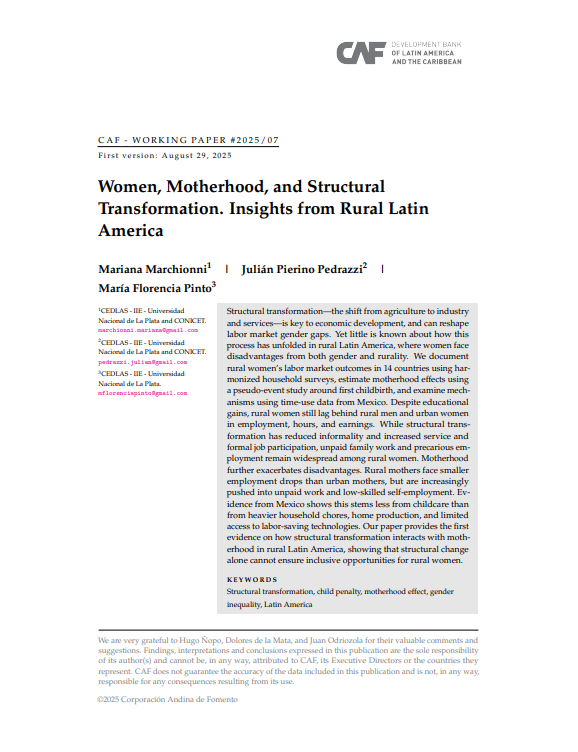
Women, Motherhood, and Structural Transformation. Insights from Rural Latin America
Structural transformation—the shift from agriculture to industry and services—is key to economic development and can reshape labor market gender gaps. ...
RED 2026 - Chapter 7: Employment, income, and vulnerability in rural areas
Rural areas in Latin America and the Caribbean face deep-seated inequalities. Although rural poverty has declined significantly over the past two decades, ...
Savings Groups Reduce Vulberability but have Mixed Effect on Financial Inclusion
This paper evaluates the impact of the introduction of savings groups on poverty, vulnerability, and financial inclusion outcomes in rural Peru. Using ...